



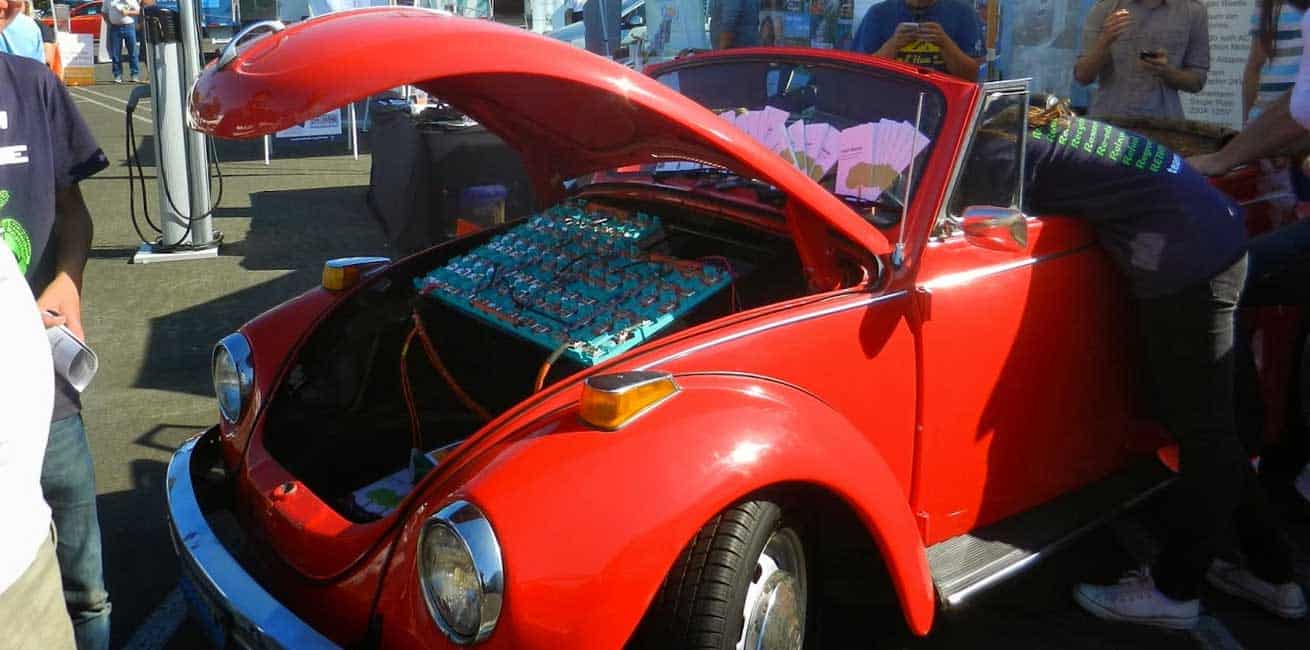

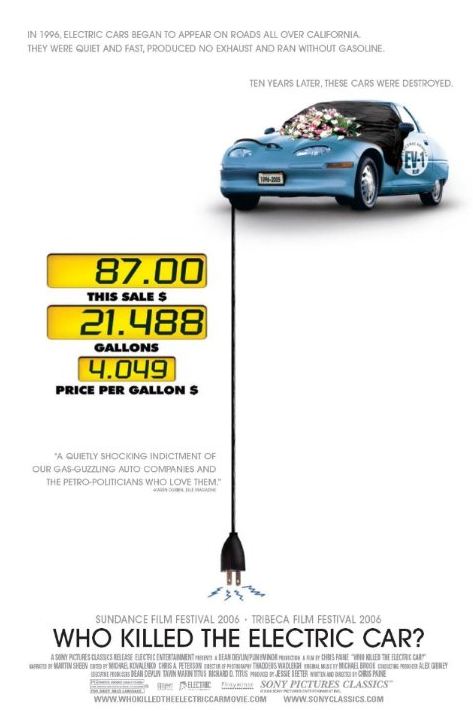
When the idea of converting my own car to electric came up, I had two goals in mind, to be able to drive a new car that would not make noise and that would cost little or nothing in fuel. The other was to once and for all stop contributing to the impoverishment and pollution of the environment in which I lived, and to be able to let others know that it is possible today to have an electric car as it was at the beginning of the 20th century in New York (See the documentary "Who killed the electric car?").
Little by little the idea became more tangible, asking around, researching on the internet and in other countries where this was already a reality, I started the project of building an electric car.
Choosing a car.
The first step, once everything was clearer, was to choose a car that was cheap and suitable for this purpose. The best cars are vintage or classic cars, the reason being that they are less sophisticated and the electronics are not essential for other functions of the car to remain operational. There is no need to panic here, nothing that cannot be overcome by reading a little about the chosen car.
Another important characteristic is that the car should be small and not weigh too much, less than 1000 kg is more than adequate, and 800 kg is ideal. The reason for this is that the heavier it is, the more resistance the car will put up due to friction with the road, and the more electrical energy it will need to drive.
Then there are elements that at high speeds also have a big influence, such as the aerodynamic coefficient, but that is a subject for the second course.
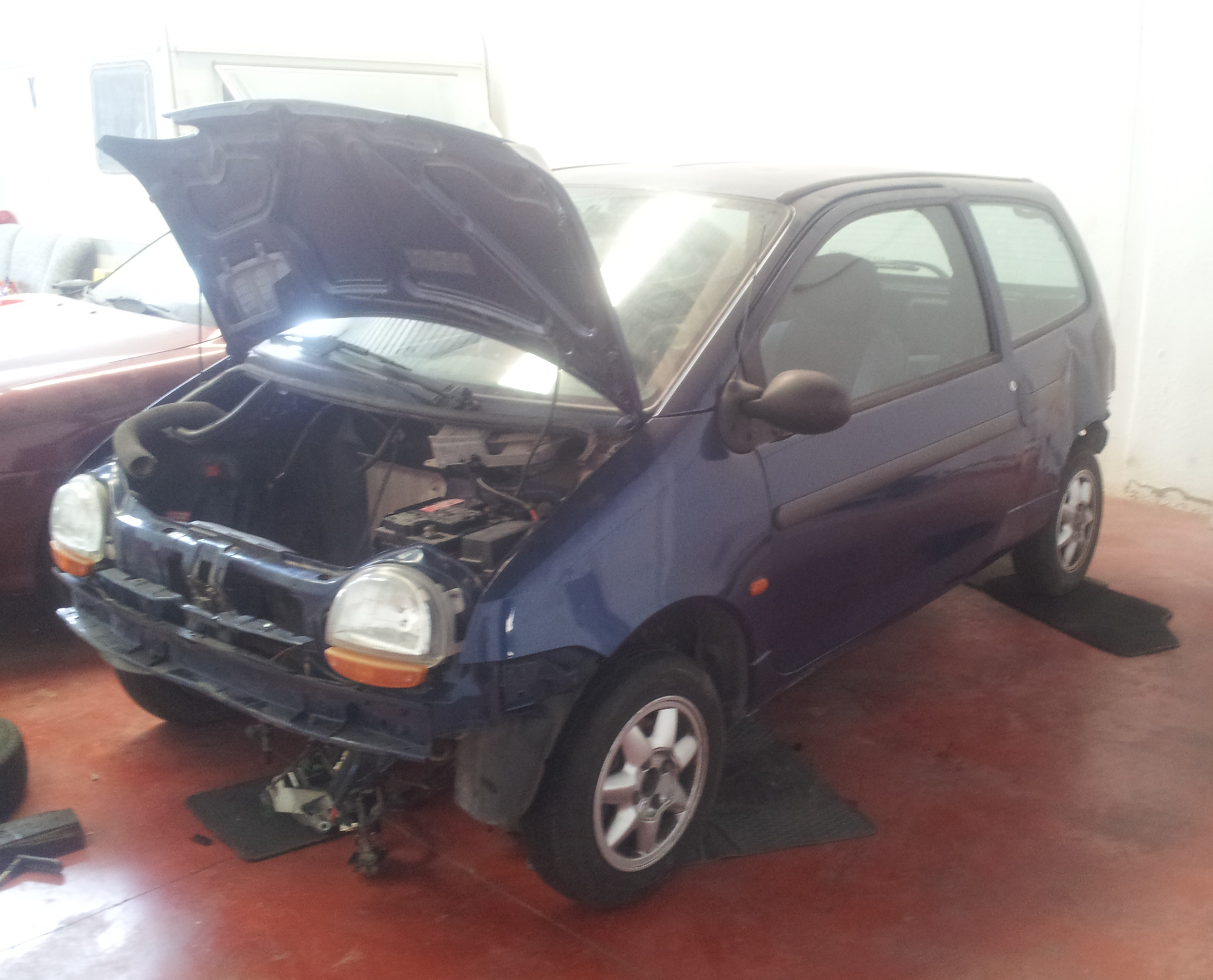
The old Renault Twingo is a light car, which does not rely much on electronics (no power steering, automatic gearbox, etc.). So I decided to buy a cheap second hand Twingo. I spent my first 500 € on this project.
And now, an engine.
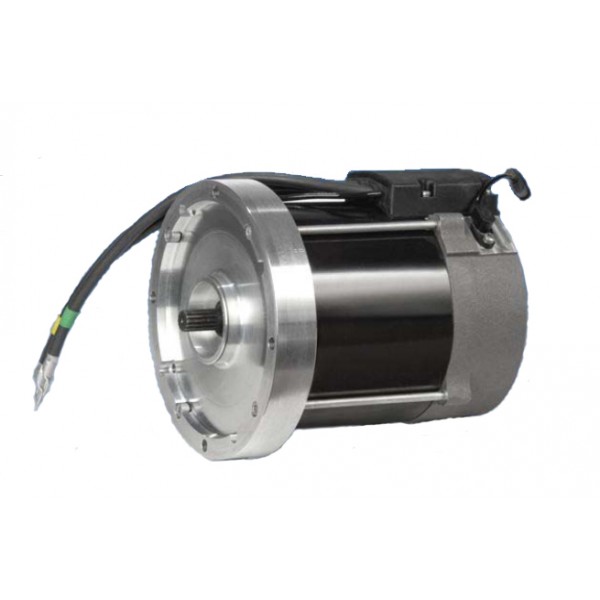
The engine is also something you need to spend some time researching to make the right choice. When choosing a small car, the engine does not have to be extremely powerful, so a 7 to 15 kW engine may be perfect.
There are two types of motors, direct current (DC) and alternating current (AC). The former are cheaper, more accessible second hand from a scrap yard and less efficient, the latter are more expensive, less heavy and more efficient. Then there are those that are synchronous or asynchronous, and those with permanent magnets, which are apparently the top of the range. As examples there are Chinese motors of 7500 W that can cost less than 1000 €, and in Europe or America you can get motors of 15 to 25 KW between 2000 to 4000 €. I decided on a 14 kW Slovenian AC motor from Letrika. I got to know this supplier at the EVS27 electric vehicle fair in 2013.
We move on to the controller.

This is also one of the main components, it is one of the most expensive and goes hand in hand with the engine, for two reasons: One because it is the one that converts the electricity from the car's batteries to the voltage needed for the motor, so it has to be able to perform that function, and the other is that it is the one that regulates the speed of the motor, so it has to be designed for that motor. Like motors, there are controllers for direct current and others for alternating current. The good news is that most motor manufacturers already manufacture the controller as well, and those that do not is because more generic controllers can be used. Controllers are also measured by the maximum current they are capable of inducing into the motor, the more current and voltage they can apply, the more powerful and more expensive they are. There are many brands as in everything, Brusa, Curtis, SAGEM,...
I bought a mid-range Curtis that works with AC motors, Curtis 1236. Most of the controllers are programmable, so you can adapt it to your motor. As with everything else, you have to study the variety and features a bit.
And then we come to the drums, the queens of the mambo.
Batteries are the most important element today, as they will decide how much power and how far the electric car can go. Hopefully the day will come when this will be the least important component, but for now the technology is very varied and more complex than we think. The choice of batteries is not only conditioned by the maximum distance we want our car to travel on a single charge, but depending on the batteries we will have to choose a specific charger for those batteries, and in some cases a battery management system (BMS), as not all batteries can be charged or discharged in the same way, and if the manufacturer's guidelines are not followed, we go from 10 years to 3... for example.
There are many technologies today, but in practical terms we can narrow them down to 3 or 4. Let's start with the cheapest ones:
– 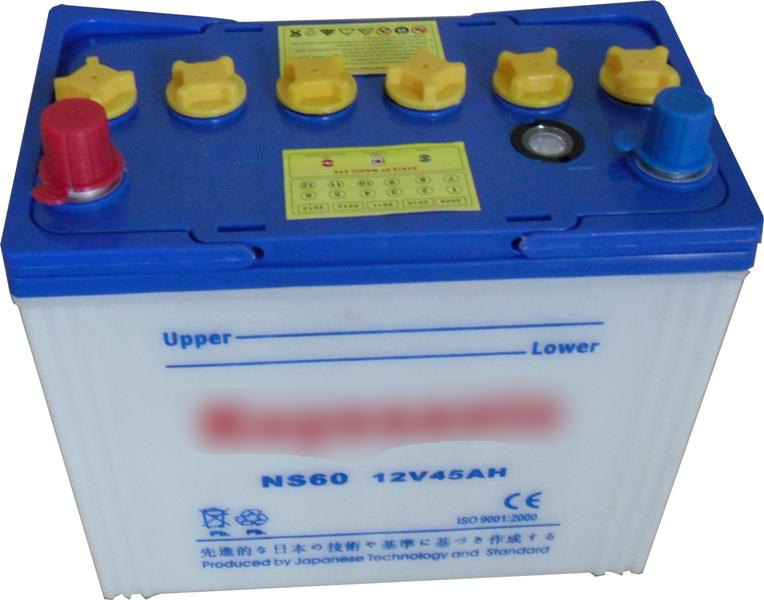 Lead-acid batteries. They are the cheapest, the least suitable by design, as they are not designed to provide a gradual current, but are designed to provide a lot of current all at once, which is not how an electric car controller would use it. Advantage, even when they are worn out, you can revive them and make them last for another 3 years. It's a bit of a delicate process, as there is sulphuric acid involved,
I therefore recommend that if you are not sure of what you are doing, don't do it. I did it, very carefully, following many guidelines, using protective measures such as gloves, goggles and mask (as the gases are toxic), of course at the end do not pour the excess acid into the sump, you have to neutralize it before so that it is not harmful to the environment. You can also buy them and avoid this mess. They are very heavy but you don't need a special charger.
- Gel or AGM batteries. They are deep cycle batteries, they are lead-acid but have a slightly more efficient gel-type electrolyte. They are a bit more expensive and their design is made for the use of an electric car. They are also very heavy, but they last longer, there are manufacturers that will give you up to 1000 charges before they start to lose capacity. The charger will have to be a bit special, as it should charge with special parameters for Gel or AGM. They are not very expensive. I bought 6 batteries of 12V and 100Ah for about 900€.
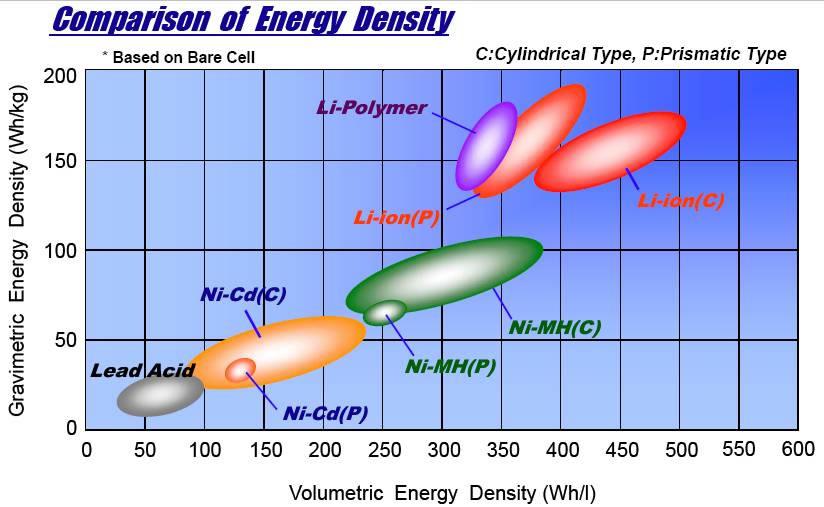
- Lithium batteries. These are a little more expensive, but weigh half as much and have twice the capacity. So they are usually the standard option in electric cars. They usually come in 3.7V cells, so you have to buy a lot of them until you get the desired voltage. Another VERY IMPORTANT issue is that these batteries have to be managed (charged and discharged) by a special battery management system for Lithium batteries. The reason for this is that they must not be discharged beyond a certain limit or charged beyond the voltage recommended by the manufacturer. For example for 18650 lithium cells, the maximum voltage is usually 4.1V and the minimum 2.5V. Although this depends on the battery and the manufacturer.

- Lithium-ferrophosphate (LiFePO4) batteries are the highest capacity commercial batteries, but they are also the most expensive.
Enough with the batteries...
Another important component, a high voltage to 12V current converter.

When we eliminate the petrol engine, one of the things we also eliminate is the alternator, which is responsible for constantly recharging the car's battery (in this case it can be called an auxiliary battery) to provide electricity for the lights, windows, radio, etc. Without an alternator, the battery would gradually wear out until it is completely empty. This is why we need a system to charge the battery, and this is a DC converter, for example from 72V to 12V. In this way the high voltage battery pack will constantly charge the auxiliary battery.
Well, that's it, isn't it? No, something very important is still missing. The brakes.
For the brakes, it is necessary to replace the vacuum that the combustion engine produced in the brake servo. For this purpose, a vacuum pump is fitted, which does exactly what it says: vacuum.

Then you need other electrical components like a potentiometer for the throttle, a contactor, which is a relay but for high voltage, a lot of cable...relays, fuses, etc.
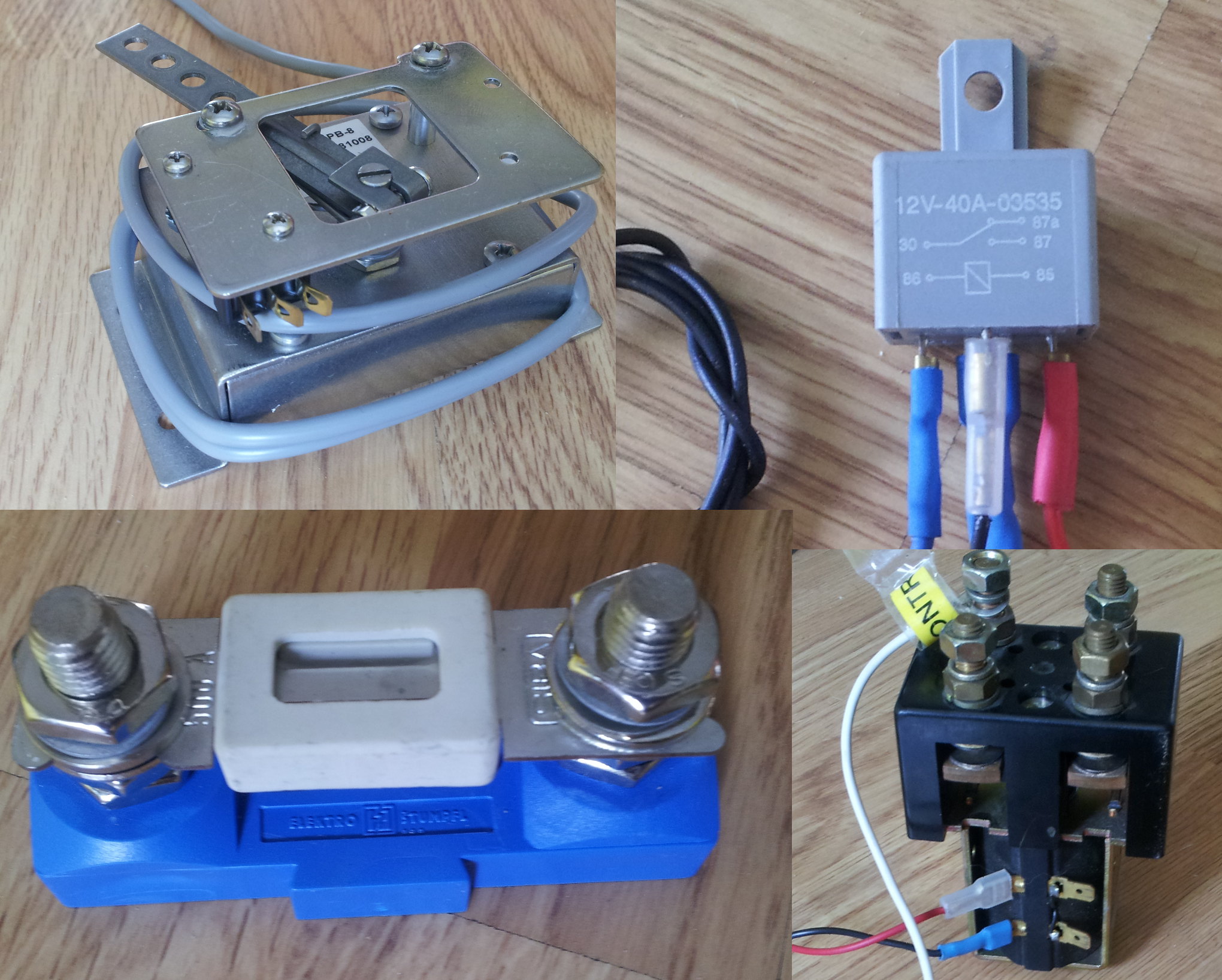
The accessory components are equally or even more important than the main components, because for example, with the motor and controller already in place, without a cable to connect it is equally important. For example, it is necessary to look at the high voltage cable requirements of the motor or controller manufacturer for the cable. Thin signal cables also have certain characteristics, not only in terms of cross-section but also in terms of insulation.
The adventure begins now, when everything is in place and needs to be installed in the car.

If you are interested in converting your car to electric and you need more information, support, documents or just someone to share the hobby with you can contact us by clicking here.
<Spectacular topic. Very interesting and I would like to be able to convert a small light car type citroen 3cv in electric.
Which motor would be the smallest that would work for me.
thank you.
Hello,
For a Citroen 3CV a small 7 kW motor and a controller would be sufficient. Such a motor would cost no more than 1000€ or 1500€. The truth is that it would be a very interesting project and not very difficult.
Cheer up.
Best regards
Great project, I am very interested, do you know how is the issue to legalise the reform in Spain?
Hello,
Yes, it is a difficult process, which is what I am going through at the moment, but it can be done. The million dollar question is, for how much money and effort? From what my experience tells me so far is that it depends on the labs and the modification. IDIADA is very expensive, each test they do is charged at about 6000€, and normally you have to do 6 to 8 tests (power test, electromagnetic compatibility test, braking test, glass test, heating test...etc). So the main thing is to look for laboratories that work more at workshop level than at the level of a large manufacturing company. On the other hand, it is important not to make too many modifications, as each one incurs a test and an expense. The minimum modifications that can be made to convert the car to 100% is what I explain in the blog.
Once I have it homologated...I will make an article about the whole process.
Best regards.
And in the end.... as of today.... September 2017.... how much did you get out of the deal?
Hello,
In total we have spent more than 20000€ with materials, tests, trials, homologation, etc.
But it will be much cheaper when we do the conversions for 20 vehicles.
Best regards
I have an important question in this section about the homologation .... let's say I have a workshop and I make a conversion to a very sold car a specific model I pass the tests and I homologate it that homologation serve me for all cars of that brand and model with the same mosificacion? I mean I could modify 100 cars the same and modified in the same way? and if so why not use the aid to the purchase of electric vehicles even if only one year to specify the modifications for conversions? so help many more to get to have an electric vehicle.
Hello,
Well, it was two questions 🙂
The first, yes, broadly speaking, if that is the case up to 499 vehicles.
Secondly, aid for the purchase of electric vehicles is only available for newly registered vehicles, as the electric vehicles we converted were already registered, ahhh, sorry. A pity.
Best regards
Extraordinary work you are doing. I'm an EVWEST fan and you don't know how happy I am to find you doing this kind of transformations. Good luck and good luck!
Thank you very much Jorge.
Good...
We are from an engineering company and we have been approached with a project of similar characteristics, but for now the obstacle we have come up against is the issue of approval, as the reform has to go through an approval authority accredited by ENAC type IDIADA or INTA and as far as I understand it is not worth the technical services of approvals, (the well-known as laboratories), of this type as they require many tests that these technical services can not accredit and the cost is very high. All this if you start from a reform of an already registered vehicle.
On the other hand, it would be to manufacture a vehicle from scratch, as far as we understand, the legalisation costs are lower although it obviously requires other things such as being registered in the RFFR and other authorisations but apparently it is less complex and costly as far as the bureaucratic part is concerned. ....
Do you know anything about this?
By the way the project is tremendous....
Greetings
We are also dealing with the bureaucracy. It is true that they ask you for a lot of tests and also depending on the transformations you do and also depending on the components used. Yes, IDIADA and INTA are the ones we have to go through the studies for now. Best regards.
I think the smartest thing to do is to have a well-maintained engine that doesn't smoke and change it once a year like we did with 50cc bikes when we were kids when we put in and took out trick engines or 125 engines.
Best wishes and good luck with the project.
Well, in this case what we are trying to do is to convert vehicles to zero emissions, to make them as sustainable as possible, to make the engines last for more than 20 years, as there are already conversions that were done in the 90s and still have the same engine. It is a different current of engineering. Best regards
Very good work. Congratulations. One observation: what would happen if you couple the motors directly with the wheels and drive the speed with the controller. Thanks
Yes that is a much more efficient design, as has already been proven in many electric trains and in Tesla itself. However, that would increase the homologation much more as there would be many more tests to completely change the design of the vehicle. Best regards.
hola como legalizo mi auto convertido en eléctrico en México.
Hello,
Well, we are in Spain. In Mexico, I suppose that the Ministry of Industry or Traffic or the competent authorities will be able to inform you there.
I'm sorry I can't be of more help.
Best regards
Alex
In Mexico, if you have the import documents and they are in accordance with the regulations, there is not so much of a problem to change the vehicle's driving licence.
We would love to be able to do it with our VW T4 california, but I guess it will be difficult at the moment due to its weight.
Hello, regarding homologation, I don't know the process or the bureaucracy, but could an ev conversion kit be homologated for a specific model of vehicle, so that all vehicles that have this kit installed by an authorised installer can receive homologation directly, as is done with towbars, anti-roll bars, etc.?
Hello,
Yes. Yes, this can be done, but the costs for this type of homologation (for a short series) are higher.
Best regards
Alex
Since the homologation issue with laboratories is a mafia and a headache. You could try and go directly to the itv and see if they pass it (you know, if you have a friend inside who will do you the favour).
If I were to pass the itv, I wouldn't have any more problems, would I, for example, if I were stopped by the police?
Hello,
Well, I wouldn't call laboratories that, it is true that regulation and directives are very complex and that makes the work more complex, expensive and sometimes subject to more subjective interpretations.
Yes, the final objective is to pass the ITV, but if a friend at the ITV passes it without the conformity report, isn't that a mafia? On the other hand, if the Guardia Civil ask you for the documentation, they can also ask you for the conformity reports as well as the technical data sheet, because if they see a major reform and you don't prove that you have the homologation, they could also get into trouble.
What we have to fight for is ease of testing, change and homogeneity of directives and regulations, rather than trying to go through the back door. In the end, what we want is for there to be as many electric cars as possible, and going through the back door as a procedure is no good.
Best regards
The truth is that if you check the regulations in other EU countries, let alone the USA or Canada, the regulations for vehicle modifications are far from being as cumbersome, expensive or limiting as they are here. That is why many manufacturers of type-approved kits opt to obtain type-approval in another EU country, with its own regulations, obtain the corresponding CE marking and export the type-approved kit to the rest of the countries, including Spain.
Hello,
Well, the regulations are the same for the whole EU, what differs from one country to another is how they are enforced or how they are considered to be enforced. We are the ones who have more problems than other countries. That's how we are doing.
Best regards
Hello Greetings.
First of all congratulate you for your work, I have a 1952 Chevrolet "Tin Woody" and I want to bring it back to life with an electric heart, what would you recommend me to read or what could you share with me to start this project.
Hello,
That vehicle looks heavy (maybe 2000 kgs), so you would need a motor of at least 25KW and a similar battery pack. A 144V electric system would be the minimum.
Hi, is it possible to convert larger vehicles, e.g. a Hummer H3?
Is it possible or would it hopefully go as fast as a golf cart?
Yes it is possible, but the economic and technical feasibility is questionable, as the number of batteries needed to power such a large vehicle would make the vehicle much heavier and economically very, very expensive.
And why are there so many conversion workshops in the USA and not here, are they dumber or are our compatriots from the homologations the smart ones?
Well, perhaps the question is, why are there so few conversion workshops in Spain? The answer is the enormous difficulty of the Spanish bureaucracy to homologate conversions.
This is a political question and it is solved with politics. Once again, the economic and political elites represented by PP and C ' s make it difficult for the average Spaniard to develop. It is necessary to demand the cheapening of these approvals from the left-wing parties and thus put an end to the aristocratic regime that exists in Spain when it comes to setting up a company, where they put you in trouble even for sunbathing, and which is also a brake on the creation of companies and jobs, and is the main reason for unemployment in Spain. This is a serious problem that deserves our attention.
The disadvantage is that it is the European political elites who decide on directives and regulations, so you have to go a bit higher.
Best regards
VERY GOOD INFORMATION, THANK YOU VERY MUCH FOR SHARING IT,
I AM DESIGNING A VEHICLE IN WHICH I CAN CROSS THE CONTINENT DOING DIFFERENT ACTIVITIES, I NEED AN ALL TERRAIN VEHICLE WHICH REQUIRES MORE CAPACITY.
ANY KIND OF INFORMATION OR ADVICE WOULD BE MOST WELCOME.
GREETINGS
Hello Juaner. It is not clear which continent you are referring to. But we would love to see your vehicle finished and working. I understand that in a project like this you will need a fairly large battery pack, for a 4×4 and to be able to do 150Kms, you would probably need at least a 40kw battery pack, this can be about 20000€ perfectly. Then, you will have to stop to recharge the batteries, and back to continue touring the continent. Best regards and good luck.
Hi, I don't know much about homologations, but couldn't a complete conversion kit for a specific model of car be homologated as well as the trailer hitches?
This would make bureaucracy much cheaper. I guess it won't be much of a business for now, but the day batteries become cheaper, it will be the business of the century.
Hi Rober. Yes, it can be done, and it would work for the same vehicle model. But this is also expensive, in this case what you save is to test the other vehicles again, but the first conformity report is also expensive. Best regards
EXCELLENT TOPIC I WOULD LIKE TO KNOW IF YOU COULD GET ME A 7KW ELECTRIC MOTOR AS I WOULD LIKE TO DO THE SAME TO START THIS PROJECT.
Hi cesar. Thank you for your comment. Unfortunately we don't sell engines, but a google search will find you a lot of suppliers. Best regards
I have spoken a few times about the issue of homologations with a half English-Spanish friend, and he told me that there is a company that sends transformed vehicles to the UK, where the transformations are almost free (simply with the signature of an expert and little more would be enough) and when the vehicle is imported back to our country, at least until Brexit comes into force, as it is homologated in an EEC country, it could already circulate in any EU country.
The "trap door" would be in export-import, the company he told me about I think is in Barcelona, and at the moment it seems to me one of the most viable ways to solve the Spanish bureaucracy.
Best wishes and good luck with this great project.
Hi. Well, there is really no catch. Any vehicle registered in the EU can drive for 6 months in any EU country. Once Brexit comes in, we don't know how the traffic treaties with the EU will work, they will probably stay as they are. We will see. Best regards.
Excellent! I hope you can get it homologated soon. I would love to start a car conversion company, but the money needed is what holds everything back, as always, I think it is the most logical step, in the next few years, because I see that the car manufacturers, are too slow with bringing out electric cars. The transformation to electric is ideal for classic cars or for cars with serious engine problems, but the rest of the car is fine. If I can help you with this idea, it is possible, since you are homologating, that instead of homologating the car, what you homologate is the electrical system, with that, you could put it in more cars, without the need for large unit homologations. Like the extra parts that are fitted. Greetings and go ahead, because it is a great project !
Thank you. But it is not quite like that. The homologation or the report of conformity of the modifications made is not valid for any model of vehicle. Even if I did the homologation for this Renault Twingo, the homologation would not be valid for other Twingos, it would be valid for other Twingos of the same year or range of years, with the same components and assembled in exactly the same way. This would mean that it would not have to pass the laboratory tests, and the laboratory would simply check that it is the same vehicle, with the same components and assembled in the same way.
This is what I have been told by the laboratories I have spoken with.
Congratulations for the initiative, I would love to do the same in an e30 cabrio, but I think that the bureaucracy will leave the subject parked for me for a long time. Looking forward to seeing the outcome.
Thank you. We have had a break with the gearbox so we are still working on the prototype. Best regards
Good morning! Great Blog! I have a question regarding homologation. If I buy an electric conversion car in Holland or Germany, where I think the homologation is much simpler and faster, to bring it from import (homologated in the country of origin, within the European Union), would only have to pass an itv as a normal electric car no? or would you need the different tests of the laboratories in Spain, although the car is already legally approved in the European Union?
Thank you
I understand from what I have spoken to laboratories in Spain that the conformity report will be passed to you, but only if the homologation documentation for the country comes from a serious European entity, and by serious I mean an official entity. Once I was told that if the documentation came from Talleres Paquito in Holland, the lab in Spain probably doesn't trust them, and they make you pass the tests here as well.
Hello, I loved the blog, I have a porsche 944, which I would not mind doing the conversion, but apart from the costs and head warms you complicate your life to homologate it, that the vehicle must be in perfect condition to circulate, but that should not involve taking the money for the nose, sure that there are much cheaper ways to homologate it, see USA, but then they would not take so much money from you, neither would they cut the wings to so many very capable people that could make of these conversions and others their way of life, this could also create many jobs, butoooo......
In short, for the moment, we will observe how you are doing and how the issue finally turns out and let's hope that in the future this will change and we will be allowed to give free rein to our imagination and ingenuity without having to win the lottery to do so.
Congratulations on the work, and you will keep us posted.
Thank you very much. I agree with your position, although it doesn't look like this is going to change or be simplified, so we have to adapt. The best way is to do several (ten or more) homologations at the same time to make lab tests cost-effective. We plan to start a project of 12 Smarts.
Best regards
hello all, I am studying the possibility of modifying/converting my 99 Fiat Coupe ( Pininfariana ) into an electric passenger car that does not differ much in performance from the potty, as far as my economy allows me to do so.
Point number one: Around 100hp, which theoretically (100% of torque) yields about 140hp of the original.
Secondly, a range of 250km being moderate, to know that in real conditions it will reach 120km per charge.
Third point, and possibly the critical point of the transformation, legalising the vehicle, since in Spain this will possibly be typified in the penal code as terrorism (irony), I would not want to spend more money on paperwork than on batteries.
So, having said that, what I am looking for is information on administrative obstacles and how to overcome or avoid them,
companies that are dedicated to homologate this type of projects, and if anyone knows of kits that are sold already prepared to attach to the gearbox with its specific controller, regarding the mechanical, electrical and electronic I have no problem, I can do everything in my workshop. thank you very much in advance.
Hello Armando,
Unfortunately the bureaucratic hurdles cannot be avoided but they can be cushioned by making several Fiat Coupes. Here you can see what homologation in Spain is all about: http://elektrun.com/homologar-en-espana-el-gran-paso/
We are also preparing some kits (relatively universal) which would lack the design of the adapter plate and the coupler. Some AC motors of 7,5Kw, plus the controller for 72 V, charger, converter, contactor, key, gear slectro and accessories. We hope to be able to get it for around 3000€ more or less. We will announce it on the web. Best regards
I love the idea, that way you can keep your classic car and drive it more on a daily basis. I would like to do it with a vw t2
I am very happy to finally see a website dedicated to this in Spain. It's quite an odyssey. I hope you keep updating your project, I will follow it with great curiosity. I would love someday to be able to make a similar transformation of a mx5 nb.
Isn't there a workshop that does the conversion?
Thank you
Hello Miguel,
This is really something that no garage is going to get into because of the time it takes to do it and the difficulty of homologation. Workshops need to make quick changes and repairs, otherwise it is not profitable.
We will soon launch a project to convert 12 Smarts, which is the only way to make components, homologation and assembly profitable and viable.
Best regards
So the project went ahead?
Hello,
Yes, it did.
Best regards
Hello, I am very interested in the smart conversation. How can I join your project?
Hello,
I see that you already did it through the contact page. You were already registered.
Best regards
As for the power of the electric motor...if a normal car has 100hp which is about 75 kw more or less, how come you put a 12 kw electric motor in it?
Hello Xavi,
The Kw equivalence of a combustion engine and an electric motor, for some reason, is not the same in real power. I suppose that the torque of the engine is also taken into account. That is to say that 14kw electric motors have a power curve in which at certain rpm they achieve the maximum torque that the combustion engine achieved at the same rpm.
There are great debates about this on the internet, and yes, it is confusing.
Best regards
Where can I buy all the necessary parts? Engine, etc..
Well, there are now starting to be suppliers on the Internet that sell you all the components you need, without having to go to different suppliers.
An internet search for "EV components" or "EV motor" or "AC motor" will give you enough suppliers.
Best regards
Good morning. I loved this page that a friend passed on to me. Very good work. As in Spain is very difficult economically to homologate... I would like to do this sometime with a buggy, buy it without engine and install an electric kit, in principle without registration. But if it's easier to homologate a buggy than a car, then maybe I'd like to do it.
Cheer up with the project! We need more entrepreneurs like you. One question, are there any photos of the assembly and conversion of the project?
Best regards and good luck with the approvals.
Hello, I love this subject and I have been thinking about it for a long time. It is clear that the issue of type approval is an insurmountable obstacle in this country. It is a retaining wall to stop the natural evolution of things and thus continue to benefit those who would be the big losers, the energy companies and manufacturers of conventional engines, who with their money buy wills and entire governments. We only have to remember the words of our former Minister of Energy and Industry, Mr. Soria, when he imposed the sun tax and said that self-supply was unsustainable.
What needs to be done is to look for alternatives for homologation elsewhere, be it in Gibraltar, Andorra or Portugal, so as not to be too far away if possible.
Hello
Reading your post I love the idea
Doing "crazy things" doesn't scare me, it's not something I find so difficult to do.
I only see one problem, I live in the Canary Islands and idiada and intra are in the peninsula, taking the car for the tests would be crazy.
I certainly don't dare, but would there be a company that could convert my Mercedes C200 into an electric car? Including taking care of the bureaucracy.
I'm afraid it's a very heavy car.
Hello,
If it is a very heavy vehicle. The investment would be quite expensive.
Best regards
It really is a great blog, I also have a crazy idea to convert, in my case, a large volume van, I know I have the inconvenience of the batteries but I will have plenty of place to house them, a query, in the EU countries closer as Portugal, France and even Germany as is this issue? It is a good idea to join several to do it in the same model and all together to cover the costs and it would be like "JURISPRUDENCE" made with the first would serve for the rest, always talking about the same model, call Smart, Twingo, etc.. A thousand congratulations for the project and above all for trying to overcome the bureaucracy, as already said, it would be very good to be able to do it in Spain,
Good from Seville, many years ago I am behind to convert a combustion car to electric, after much digging, the issue of bureaucracy is always what has always stopped me, but something occurs to me now that I read the comments, if as you say to several people, that if a car is approved once and you can make the conversion to the same model as many cars you want, why don't you look at the budget, create a community and pay for the homologation in equal parts, looking for a number of people so that the homologation is not too expensive between all, I hope you understand what I mean, if you are encouraged to do so count me in, greetings and courage with the project.
Great. Lots of encouragement and go ahead with this magnificent project!
How are the dozen smarts and their homologation going, have you already passed any trials or tests?
I am also very interested in doing a conversion, but if you sell any of the smarts I might be interested if the price is affordable. Thanks for your initiative and great work.
Kind regards.
Hello,
The dozen Smarts are already 20. It is the minimum number to be viable, because the legislation has changed and now the batteries also have to be homologated, and this test is charged at 30,000€. But that doesn't stop us, it makes us stronger.
The design of the Smart is almost finished and we will start assembling the zero unit very soon.
Best regards
We have started this campaign in change to collect signatures to eliminate the high fees when converting to electric vehicles. https://www.change.org/p/gobierno-de-espa%C3%B1a-homologaci%C3%B3n-gratuita-para-conversi%C3%B3n-de-veh%C3%ADculos-t%C3%A9rmicos-a-electricos I hope you will support and sign a greeting to all of you
THANK YOU FOR SHARING THIS PROJECT AND EXPERIENCE, GOOD LUCK IN EVERYTHING.
BUT I MUST SAY THAT WE LIVE IN A SHITTY COUNTRY... THAT FOR HOMOLOGATION, PATENTING, AND PAPERWORK THERE IS NO ONE TO BEAT, HERE EVERYONE WANTS TO SUCK FROM THE POT AND HINDER EVERYTHING...
SINCERELY, GOOD LUCK TO ALL THE PROJECTS, REALLY, RECYCLING CARS WOULD BE IDEAL, ECOLOGICAL AND HEALTHY FOR EVERYONE, EVEN IF THEY HAD AN EXPIRY DATE AT THE END DUE TO AGE, OR WHATEVER YOU WANT, BUT DO NOT PUT EXCESSIVE COSTS OR HORRENDOUS PROCEDURES.
THIS SHOULD BE CHANGED NOW !!!
IT DISGUSTS ME! I'M SORRY IT SINKS ANYONE IN THEIR ILLUSIONS AND PROJECTS.
AN ITV WITH MODIFICATION OF THE TECHNICAL DATA SHEET AND A UNIQUE HOMOLOGATION IN INDUSTRY AND THAT'S IT, AS AN EXTRA... AN ECO STICKER AND YOU CAN DRIVE...
Good afternoon:
I started the restoration of a Seat 600 D 2nd generation of 1967, I have it very advanced and pending to decide whether to reassemble the original engine or install an electric motor, which was my intention, until I discovered the legal procedures that I have to go through to homologate the reform, the cost exceeds more than double the cost of the reform, so I am not willing to go through a monopoly that INTA and IDIADA maintain. If in the end I do the conversion I will use it illegally with the risk of being hunted down and fined.
I see that many people are in the same situation, which leads me to ask if instead of exposing this case, we can do something else and start a bit of a revolution taking advantage of social networks so that this becomes known by many people and the politicians who legislate are committed. Here the question is to soften the legal procedures in terms of costs and bureaucracy, as opposed to showing society how prohibitive it is and how advantageous it would be to carry out these conversions that would reduce emissions.
It should be borne in mind that the automotive sector is also opposed to this type of action, as it is criticised that Spain's vehicle fleet is over 12 years old and the ITV's are already making it difficult for vehicles older than 10 years to get their owners to consider changing their vehicles.
We could open a debate in which we could contribute ideas to bring about a change in this country's legislation, which is so prohibitive in many respects.
Congratulations on your achievement and good luck!
well that's good
Hi A.D., like most people here I am very interested in the transition to electric mobility, especially conversion. I wanted to ask if there is any possibility to visit your project? Or if there is someone in the process who would like to share their experience?
Hello,
We have moved to Madrid. Get in touch with us using the form on the contact page and of course you can come and visit us.
Best regards
Excellent, congratulations, good material.
I would like to convert a small Daihatsu Cuore petrol car to electric.
To know the average cost of all conversion accessories including everything
Hi A.D. your last comment is from February 2017, more than 1 year has passed and I assume you have made progress on your project to convert 12 smarts.
I for one found this page today 11 April 2018 and find it an exciting topic, so I would like this "blog" to never end.
Hello,
Sorry for the laziness in updating. But we are active and the Smarts project is almost finished. Get in touch via the contact page.
A greeting
Great project and fabulous ideas you have used in your project. I would like to follow the blog and keep up to date with new technologies and ideas.
I have a chebrolet orlando 160 hp and I am willing to convert it to electric as soon as possible I want you to give me advice and even if I should take it to another country to convert it, if possible I would like you to advise me because I want to do it as soon as possible..thanks.
Good. I love people like this, lots of encouragement for you to get a good car and show it to us to make us envious. I have many questions but I just throw you a . can homologate pass itv etc.. In spain or they don't let you they put you pegas they don't agree etc etc. greetings artist.
Yes, it is difficult, but it can be done. And together, it's even easier.
Hello good, I'm starting to look at this topic, I think the last comment is from 2017, are you still at the bottom of the cannon or you left it because it was impossible? Best regards.
Yes, sorry, we are still active. Mea culpa for not updating the post.
Hi A D, I read with great interest your blog and all the comments and questions. I congratulate you! I think it is excellent.
But the big question remains unanswered: .... did you finally get your electric car homologated?
My project would be to electrify a Citroën two-horse, my car of youth, and I have seen examples in France and the Netherlands .....
If they are homologated there, .... could they be imported?
Thank you
David
Hello,
Thank you very much.
Yes, we got the Renault Twingo homologated.
A 2CV is a very cool transformation, sign up via the form on the contact page for when we are 20 interested.
Best regards
Hi, how is the Smart conversion project going? I haven't seen any updates for some time now.
Regarding batteries, I've seen a video of a guy who assembles a pack with 18650 cells taken from used PC batteries. He says it is similar to TESLA batteries, and many of the PC batteries that are discarded can be reused. I have opened one that was broken, and indeed 4 of the 6 elements are good, only 2 were broken. If we take a bunch of these batteries from a clean point, open them and recover the cells that still work, you can assemble a battery bank for the car for very little money. I'm going to test it first by assembling one for my electric scooter.
What do you think? Here is the link to the video: https://www.youtube.com/watch?v=Mvy3g_NIr8s
Greetings
Juanjo.
Hello,
The Smart project is moving forward, we already have the design and soon we will assemble the zero unit, to homologate it and gather the 20 interested parties.
Regarding battery mounting, this is the last aspect of the design that we are finishing, and there are two options, 18650 batteries like the Tesla, or envelope type, each with their advantages and disadvantages.
JehuGarcia's videos are really great.
Thank you and best regards
Hello, all these comments are relatively old. I wanted to ask you how the project is going, if you are still working on it or if you have given up because it is impossible.
Best regards and I hope you will continue to keep up the good work.
HOla,
We are still so active that we don't have time to update the website. But yes, the project is getting more and more active.
Best regards
Congratulations
A big step towards clearing the Lungs of Humanity and Our Wonderful Planet.
I have in South America several Volkswagen VW Petas or Fuscas.
Please send me your email and Skype and if you can your mobile number and WhatsApp. I would like to talk to you urgently because I was about to invest in a good Tesla electric car and I would love to chat with you. I will definitely not buy the Tesla.
My e-mail address is:
leds.cobb@xxxxxx
My WhatsApp mobile is :
+591 784xxxx
Thank you in advance.
Yours sincerely
Jose F. Gonzales
Hello,
Please contact us using the form on the contact page.
Best regards
Hello good, just my desire to make a transformation to electric has brought me here, and reading all the comments, I summarize that the great difficulty that we all find that we have this project in mind lies in the approvals, and I would like to know what is the process to follow regarding them and also to know at what point you are you and what solutions you have.
Thank you very much and keep up the good cheer!
Hello,
Well, it is true that a large part of the difficulty lies in the bureaucracy of homologation, but as this cannot be changed (at least for now), the other option is to eliminate the other part of the difficulty, which is to try to do a conversion on your own.
We are making a database of all interested parties by model, and each model will be transformed as we reach 20 vehicles, which is when the feasibility for the 20 transformations begins, keeping the price low in costs for the 20 interested parties.
So we are not going to cry about the bureaucratic difficulties, and we have solved it that way.
So if you are interested, please contact us using the contact form on the contact page.
http://elektrun.com/contacto-elektrun-cars/
... tell us which model you would like to transform, and we will put you on a list. We will publish the figures of these lists soon, such as which projects have more votes, how many participants there are in each project, etc... to see which are the most desired models and start with those.
One very important thing is that the most expensive part of the conversion is the components and batteries, so you don't save anything by dusting off an old car if it is not attractive enough for the rest of the interested parties. That is to say, maybe someone has an old Peugeot 205 in the garage and wants to convert it, but the cost of this car or similar can be 500€, and if nobody else is interested in it, it might be worth buying a second hand car just as cheap in which there is interest, to the point of having 20 interested parties.
How I roll.
Best regards
Hello group, thank you for what you publish especially for the purpose of breathing and recycling vehicles that are now being lost as pieces in history, maintaining the climate (which politicians talk so much about, but do nothing) hindering the progress towards easy and cheap clean things (of course they are not interested in the economic power ¡¡ )
say that I have 1 Fiat Fiorino Micro-vett with 22,000 km year 2011 broken down , that Fiat is not responsible for ANYTHING even though they are legally obliged , not even provide information because they say they no longer have anything , The ITALIAN company has gone bankrupt in 2012 and there is no way to have assistance or programs or schemes , etc etc .
My question is: could I use a kit keeping the EIG batteries and the inverter and ANSALDO motor, changing the charger and the necessary parts? I am thinking about the possibility of doing so, as I have been searching intensively for information for 5 months and nothing at all.
Or if someone in Spain dares to repair it, I would be happy to do it too, I have the vehicle in Barcelona.
Thank you very much .
Carlos mitelwhastapp622051060
Hello,
Your problem is both good and bad. You have the disadvantage of not being able to go to the manufacturer for help, but the advantage that they have an approved electric chassis, which for electric conversions is like gold. In other words, the hardest part is already there. Normally, without looking at anything, the weakest point could be the BMS of the batteries or maybe the controller. You could keep the battery cells, but not the BMS, although all this until you analyse the vehicle and see where the fault lies is a long shot. It's a pity Fiat doesn't want to get involved, but this is happening all over Europe, companies launching a small run of vehicles and then discovering that the business is not what they wanted it to be, and bye bye.
Contact us through the form and we will see how we can help you.
Best regards
Hello from Africa
please..instead of a car I want to adapt this system to a 10mt fishing boat, but without energy accumulation..I don't need batteries..pirfi ideas..!!!!!
Hello,
We don't work with boats, although I suppose it would be the same concept, look for an electric motor that has a similar power graph to the motor you are replacing.
In other words, if your engine gives you a torque of, for example, 130Nm at 300 rpm, you have to look for an engine with those characteristics.
Best regards
Hello, I have a small car, fiat panda model with petrol engine, how much can it cost me to change it?
Hello Francisco Javier,
Please contact us via the contact form and we will give you more details in particular.
Best regards
I am following you with interest, lots of encouragement. I think that if you publish the number of people who are interested in each model it is easy to encourage the rest of us.
In my case, I would buy a car specifically.
Hello,
So far there are about 800 petitions.
Best regards
Hi, a couple of questions, the engine goes to the original transmission of the car? the gearbox times I guess the electronic controller will do it. How do you solve the heating and air conditioning issue?
thank you, I find it a very interesting topic
Yes, the electric motor is coupled to the gearbox. The heating and air conditioning with electric heating and an electric compressor as well. Best regards.
On the homologation of vehicles in Spain: it is most regrettable!
Just like trying to homologate your own amateur-built aircraft, even if it is made with internationally recognised plans and diagrams. It takes a lot of euros, endless tests and you also have to build two copies of the plane, one of them for the INTA to do a series of destructive tests (in other words, they will break it, it's that simple!).
And about possible conversions of vehicles to electric, it is exactly what the most experts of this blog and others comment; the Spanish state does everything possible to prevent these conversions by making them as expensive as possible in approvals and certifications, without considering that many of you are qualified engineers. In other words: if you want an electric vehicle, you have to scrape your pocket and buy a new one. so, pensioners, with little money, even if we have enough knowledge, to screw us!
I for one will stick with my Ford Mondeo TDCI until I say enough is enough.
Greetings to all!
Hello, I have a garage, the question is, is there an assembly kit to offer to potential customers who are interested in converting their car? And is homologation possible?
Thank you.
Hello,
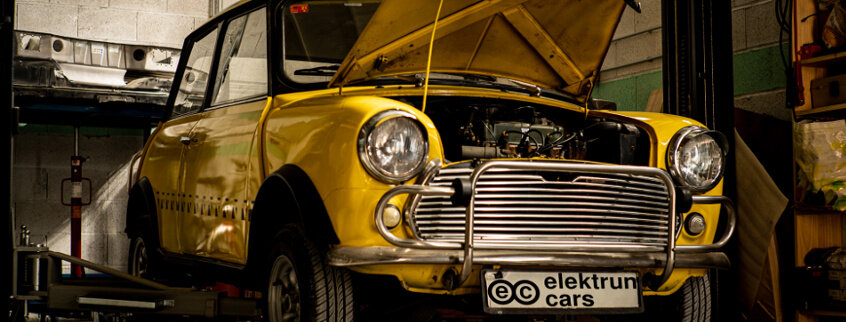
We are working on a standard kit that will be homologated initially for the classic Mini and later for other models.
Best regards
Hi, I have read about the kit for the mini classic and I am interested in more information.
How is it going?
thank you
We are finishing the development of the project to launch it. If you haven't signed up, please do so in the contact form. Best regards.
Hi, are there any electric motors that are equivalent to approximately 200 hp of power from a combustion engine? I want to build a fibreglass replica of a classic sports car and I would like it to be electric, taking advantage of the low weight of the fibreglass body it would be great to get a powerful electric motor. Thank you very much!
Hello Marcos,
Yes, there are engines in all power, torque and rpms ranges... from 1hp to 500hp...
I love the project, I am in something similar but with motorbikes, I am a motorbike mechanic and my idea is to convert them, but without removing the engine, using the gearbox, eliminating only the cylinder and cylinder head, my bike is a 250cc, what engine do you recommend to have the same performance.
The golden rule, put a similar engine, with the same power and torque at similar rpm. Basically, similar power graph. Best regards.
Hello!
I am interested in knowing where the courses are held ?
Is there any kind of advice for the purchase of a car to be converted?
Thank you very much, best regards
Hello Harold,
The courses are held at our facilities, 20 minutes from Alcala de Henares. If you are interested in the training please contact us through the form, of course we can advise you on which vehicle to convert. If not, the most requested is the classic mini, which is the one we are currently working with to get the kit. Best regards