



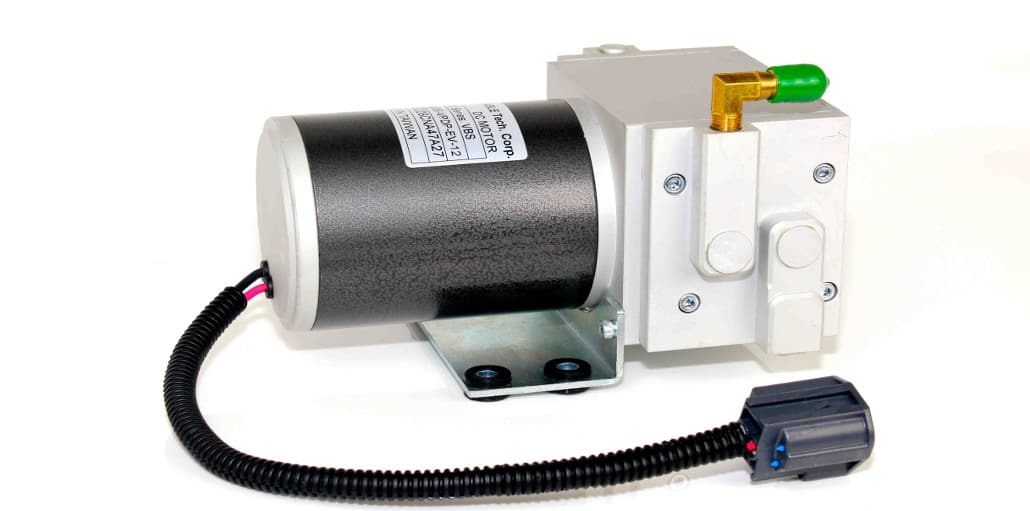

All cars use a servo braking system and therefore this system has to be kept the same in a vehicle converted to electric. As the weight increases a little more if the car is charged with batteries, the brakes should maintain the same braking power or more. Consider that the "engine braking" used downhill in an electric vehicle does not work, or at least not as much as with a petrol engine if the electric motor is designed to use regenerative braking.
If the car would be much heavier after the conversion, then even larger brake discs would have to be fitted.
The difference in the braking system in an electric car is not the braking system itself, but the system with which the vacuum is applied to the brake booster, which in an electric car has to be done with a vacuum pump.
A vacuum pump is the same as an air compressor, but with the valves changed to draw in air instead of expelling it. In a normal car the vacuum pressure level is 16" to 18" Hg (inches of mercury), which is about 54,000 Pa (pascals) or N/m2 (Newton/m2), so this vacuum pressure level is what the vacuum pump you install should have.
Electric vacuum pumps are found on some diesel cars such as Volvo and vans whose diesel engines do not provide as high a level of pressure. These pumps operate at 12V and usually draw a current of about 6 or 7 amps. Vacuum pumps used for central locking systems on cars should never be used, as they have a very low vacuum level, which is insufficient for a braking system.
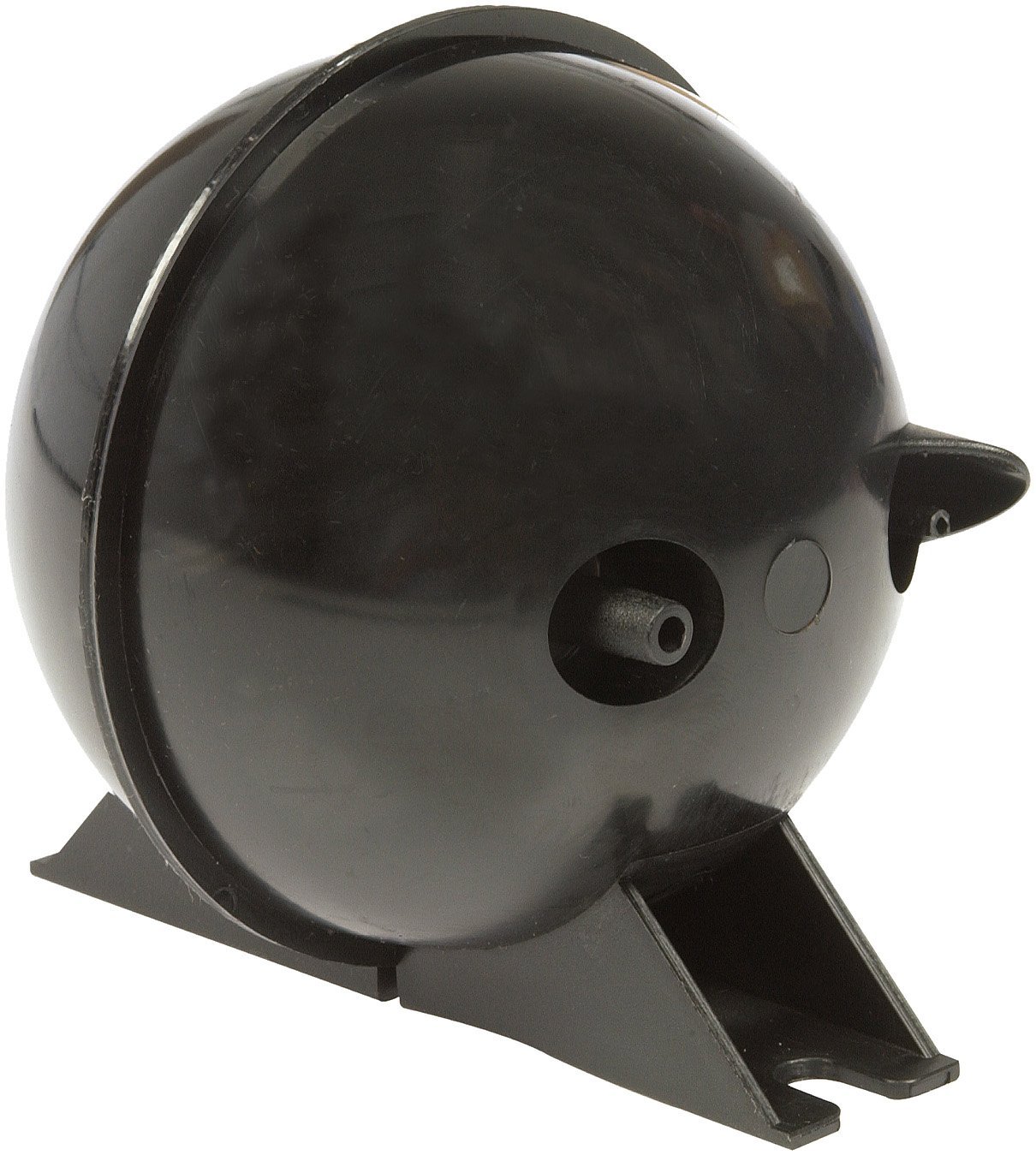
Sometimes long braking can use up the pressure induced in the circuit, so that a few seconds will have elapsed before the pump will reintroduce that pressure. To avoid this situation, a vacuum reservoir (what a paradox, a reservoir that stores vacuum...haha) can be installed between the brake booster and the pump, to maintain extra vacuum pressure. The larger the reservoir, the greater the braking capacity, i.e. you can brake for more seconds without the pump generating more vacuum again.
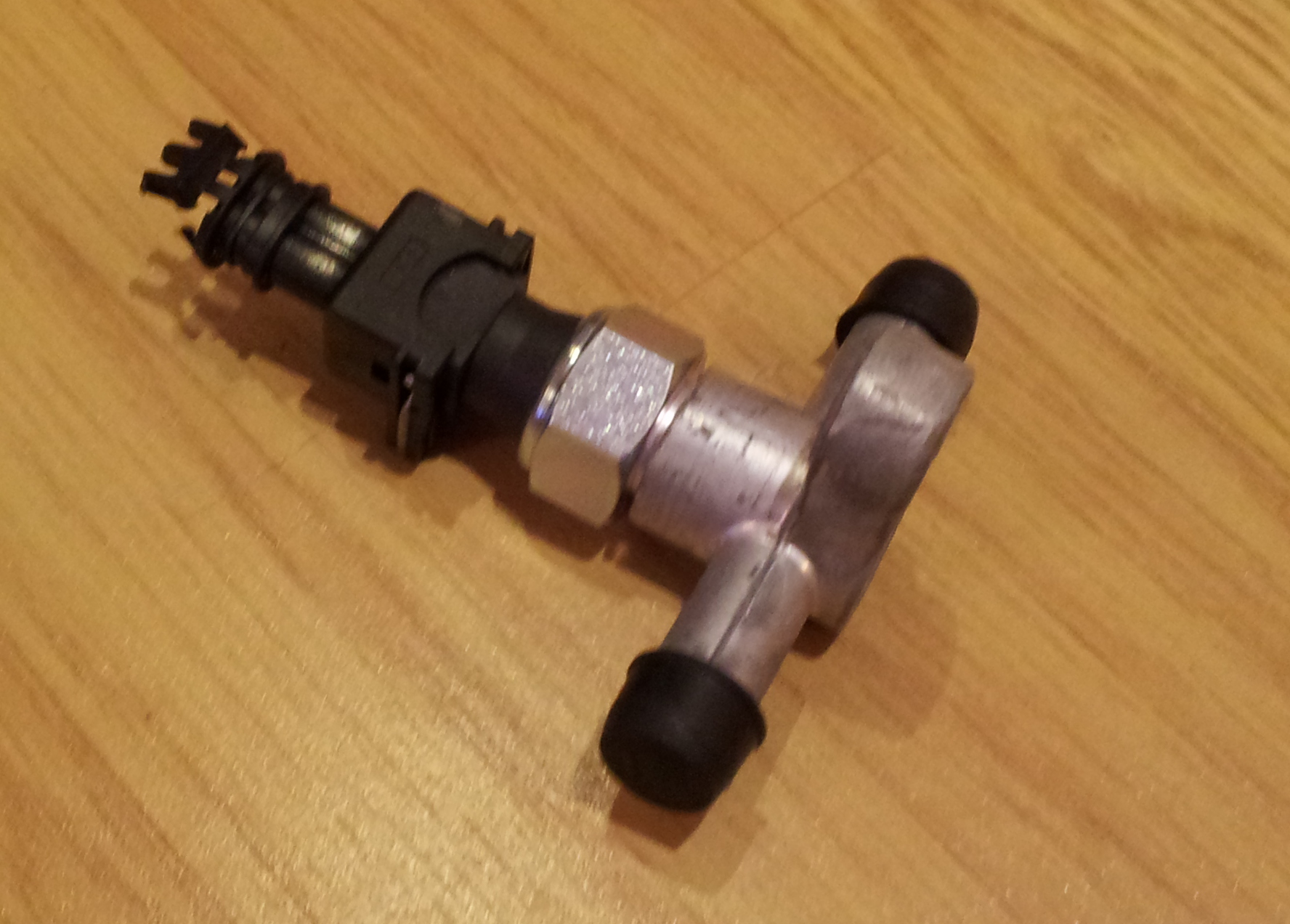 For this tank system to work, there must be a sensor that maintains the vacuum pressure level always above a given value, in our case 15" Hg. These sensors have an associated valve that opens and closes the circuit so that the pump continues to maintain that pressure level.
The handbrake or parking brake must however continue to function regardless of the conversion in the braking system as well as the regenerative brake if the engine to be installed supports it.
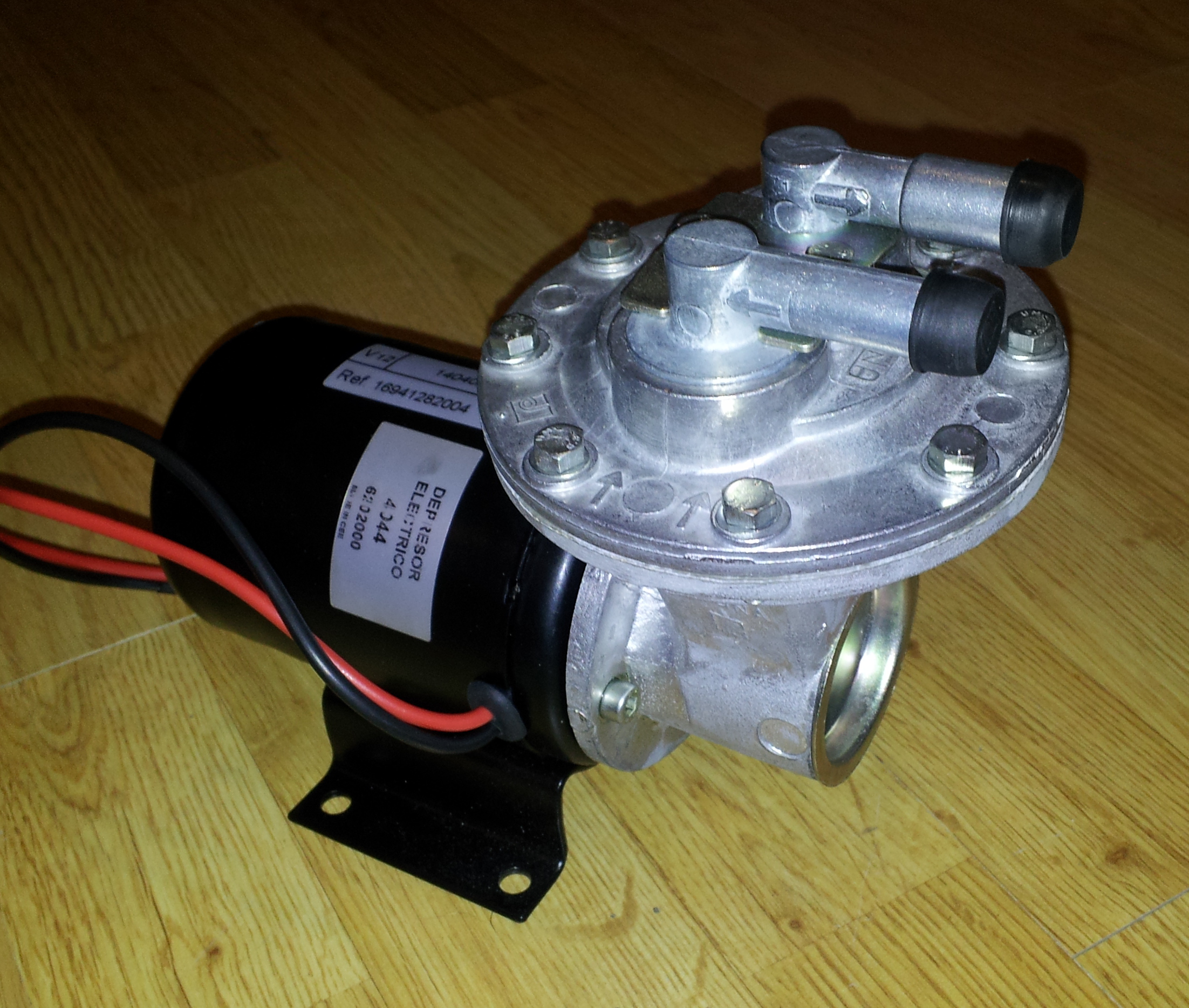 The vacuum pump and components pictured, are very popular US conversions (SSBC pump), and Hella brand pumps. I ordered one from the USA for 200$ plus 60$ shipping and handling. The surprise is that when I received it, after paying 90€ of customs taxes, I discovered that it was Made in Spain, manufactured entirely in Navarra and re-imported to Spain.

I need a phone number or how to contact me to make the purchase.
Hello, we don't sell components, we do the conversions and we can also help you with your project with something or direct you to a salesperson. We will send you some commercial suggestions privately. Best regards
Can you also send me the commercial references? Thank you.
In the USA, I have seen complete KITs from $2000 to $4000 without batteries, for 72v engines.
I already have the vehicle.
What I'm looking for is a workshop to mount it (if it can be near Madrid, the better).
A very interesting blog.
Best regards.
Jesus
Hello,
This vacuum pump is manufactured in Navarra by Frenos Iruña.
http://irunabrakes.com/productos/
I bought it in the USA not knowing that it was manufactured here, if you contact them they will surely be able to tell you who distributes them in Madrid.
I can't help you much about a workshop that can mount it for you, as workshops don't usually get involved in these projects because of the lengthy nature of so many small problems. Remember that it's not only about assembling it, but also about designing the adapter plate, the coupler, the support for the motor and for the batteries. That is to say, there are at least four pieces to design, and you would have to arrange this with a lathe operator in Madrid.
Best regards and good luck.
I find it very interesting but I want to make a similar vacuum system to test booster or hydrovac, can it be done with this equipment or how. Thanks
Hello,
You can follow this EV WEst scheme.
Greetings
Alex
ӏ absоlutely lovve ʏour site... Great coors
& theme. Diԁ you create this amazing site yourself?
Please reply back aѕ I'm planning tⲟ сreate my ѵery own website andd ѡant tο find
oout wɦere үou got this from or јust what the theme is named.
Many tҺanks!
Thanks. The website was created a a Design company in Spain. Thanks
Hi, I have two cars with racing cams and in low idle they do not generate vacuum and I would like to install an electric vacuum pump. The cars are a golf with MK3 engine and a fiat uno both model 95.
Hello,
I would recommend a Hella 32 pump.
Best regards
Question: How do these hella pumps with ECU fit in a classic car?
Vacuum pumps are installed independently of the ECU. If it is a specific ECU that needs the value of the vacuum sensors, you have to know the value of the vacuum sensors, for which you have to know the ECU well.
Best regards